May 20, 2026
A Journal of "ALL THE BRIGHT PLACES" ~Quinn Davids
People go through life every day and it's normal. Everything is ordinary. And that's fine. That makes sense. But what most people never stop to consider is that ordinary is exactly what the day you die will look like. There is no special treatment. No warning, no cinematic buildup. Even in rare cases, like someone in a coma, the doctors don't stand at the door and say you have exactly ten hours. They give estimates. And that is the edge case. We are mostly talking about healthy people walking through ordinary days.
The truth about death is that it comes when you had plans for tomorrow. When you had something to look forward to. Maybe you had a little food you were saving. Maybe you had a gift for a friend, but you held back because you were waiting for them to apologize first. Death comes then. And the worst part is it doesn't only come for you. It walks outside too. So you might be angry with somebody, and that person dies, and the last memory you have of them is you shouting at them. How traumatic would that be?
Anyway. We are delving into "All the Bright Places."
________________________________________________________________
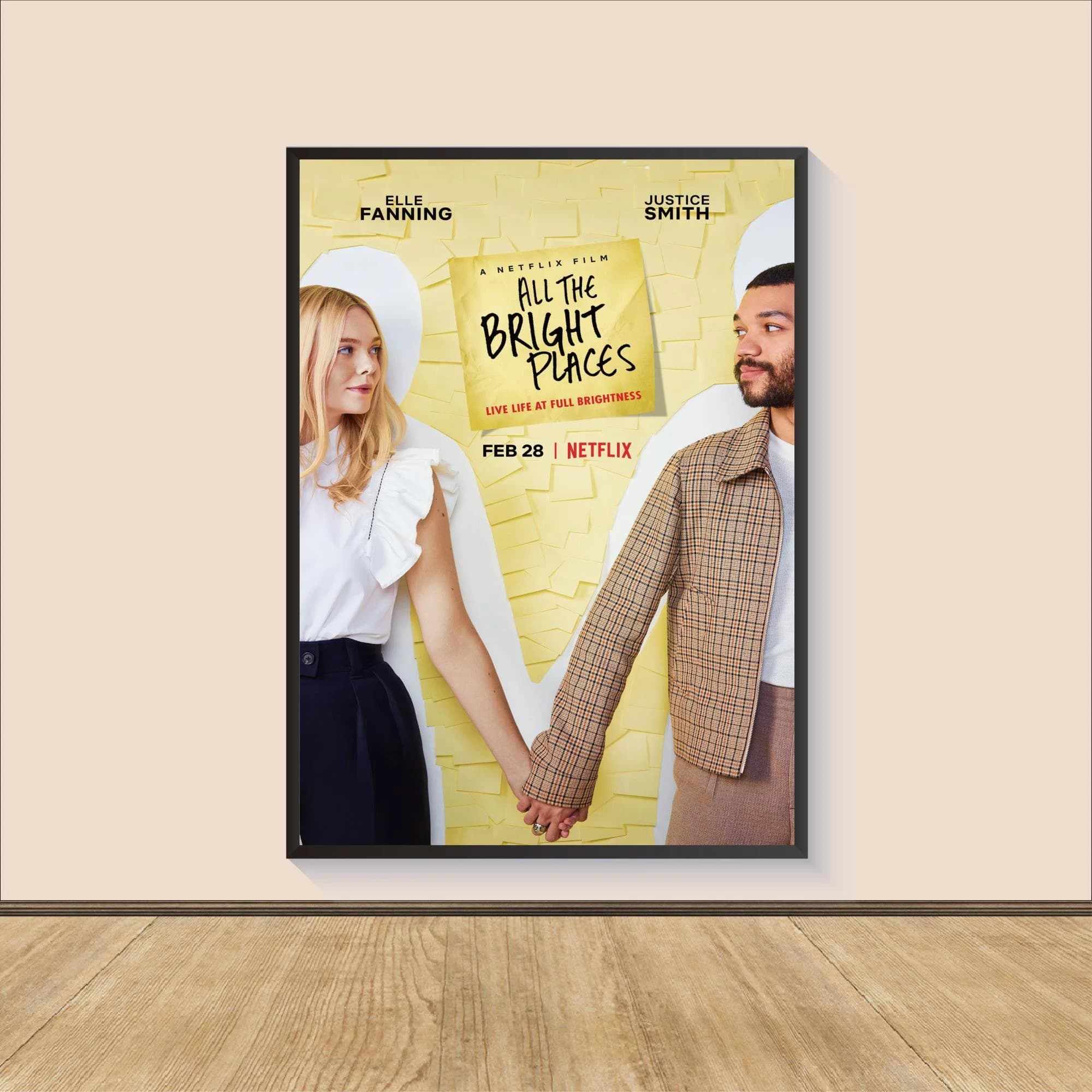
The cover looks bright and cheerful, but I find it interesting that they used a finch bird to represent Theodore Finch and a violet flower to represent Violet. It is right there in the cover art.
Finch has bipolar disorder. I won't call it extreme or mild, because that is me putting a label on it. He has bipolar disorder, and that is the central thing. He goes into depressive stages where he is completely shut off from the world. He does not want to talk to anyone. And honestly, most people can relate to that. Not because they have bipolar disorder, but because there are moments where you just want to occupy a small space quietly. You do not want to be spoken to. You just want to exist. That is not really accepted by society, is it? So instead he gets therapy sessions forced on him and gets called a freak. And the worst part is the "freak" label probably had nothing to do with his condition. It probably just came from normal high school hierarchy. Those deemed cool placed above those who are not, which is ironically a mirror of real life and society at large.
The thing I find most interesting is how the book starts. Violet is up on a ledge at school. Almost as if she wants to jump. We cannot say with certainty that she wanted to, but the fact that she is there means either she considered it or she is simply someone who likes to look at the world from above. Regardless, she was there, looking out. And Finch found her. What does he do? This boy everyone calls a freak suddenly stands beside her, almost as if it is now HIM who wants to jump. After the whole situation resolves, people ask why she saved him. Because obviously it cannot be this girl they barely know. It has to be the freak. That is what they say. And he played along with the story. That, in a nutshell, is the inciting incident. I think you can picture it.
________________________________________________________________
Now there are some quotes I want to bring up because they stayed with me.
The first is something said to Violet to encourage her to write again. It goes something like:
"Remember what Michelangelo said about sculpture? That the sculpture was already in the stone. He was just there to bring it out. Your words are already there too."
Simple, but it lands.
Then there is something Finch says:
"None of us know how long we have. Maybe another month, maybe another fifty years. I live as if I only have two days."
Which connects directly to everything I said at the start of this journal. Live like there is no tomorrow. But let's be honest. As energetic and beautiful as that sounds, it is also a little dissociated from reality. You have bills. You have relationships that need tending. Responsibilities that do not pause. So I think what we are actually chasing is the balance. Living with urgency while still being present to the weight of real life.
What I love about Finch is that whenever he is not in one of his dark stages, he is electric. He is completely alive.
He also says:
"Sometimes, Ultraviolet, things feel true to us even when they are not."
Ultraviolet is his nickname for Violet. Two interesting wordplays in one name. And that quote is a beautiful one, because it depends entirely on where you are in life. Something that sounds like the most generic statement in the world can hit you at a specific moment and feel like the truest thing you have ever heard. Not because it is poetic. Just because it is yours in that moment.
________________________________________________________________
When Violet sees a small, simple gift Finch puts together for her, she says this:
"The only thing that comes out of my mouth is 'Oh my God.' I've been so worried about him, this boy I love, more worried than I knew until right this moment, staring up at the solar system. This is the single loveliest thing anyone's ever done for me. It's movie lovely. It feels somehow epic and fragile, and I want the night to last forever, and knowing it can't already has me sad."
Love by action. That is what that is. And I love when a writer embodies a character so fully that the quotes come out like that. You are not just reading words. You are feeling something.
Then Finch says this, in a different scene:
"Love is truly the great manifesto, the urge to be, to count for something, and if death must come, to die valiantly, with acclamation, in short, to remain a memory."
To him, love is this great force that makes you want to die as a memory. Not to die violently. Just to die in a way that counts. To leave something behind. And he does embody that in the book, at the end. What happens to him isn't beautiful, not morally. But the way he embodied what he said, there is something in that.
________________________________________________________________
Then we start to see him turning. Because it is not all sunshine.
When it seems like Violet, the one person he truly loves, begins to question him, his voice turns cold instead of angry. According to Violet, cold is worse. Because cold means he stopped feeling.
Then there is the moment where Violet, banned by her parents from seeing Finch after a certain incident, had been seeing him in secret. When he goes missing and she can no longer hold it alone, she is confronted with the question: "So you've been seeing him?" And she says:
"I'm sorry. I know you're mad and disappointed, but I love him and he saved me. You can tell me later how unhappy you are with me and how I've let you down. But right now, I need to do what I can to make sure he'll be okay."
That is a person who has made up her mind.
Then things get very deep.
He goes officially missing. She remembers where he might be, goes to the river where they used to hang out, and finds his clothes. Neatly folded near the riverbank. Her mind races as she calls 911.
She cannot accept it. She says: "He's not nowhere. He's not there. He just found another world." That is grief beginning to form. She sees the clothes. She sees the water. And she is trying with everything in her to believe something else.
He had done something similar before. Staying underwater too long while they were swimming, long enough to terrify her. So when this happens, it is almost like a horrible echo.
Then they bring the body up and she says:
"Swollen and bloated and blue. That is not him. That is not someone I know or recognize. I tell them so. They ask me if I feel strong enough to identify him and I say that's not him. That's a swollen bloated dead blue thing and I can't identify it because I've never seen it before."
And she turns her head away.
Then she tells herself again: "Don't you see? People like Theodore Finch don't die. He is just wandering."
Then she goes to his mother, and his mother lets out a sound she has never heard before. "Low and guttural and terrible." That is the whole description. And it is enough. Our minds do the rest.
"I'm pinching the inside of my arm, making little red marks, because I suddenly can't feel anything."
________________________________________________________________
Then she finally, quietly, acknowledges it. She says to him: "You are all the colors in one, at full brightness."
And then she tries to remember the last words she said to him and she cannot. Only that they were angry and normal and unremarkable. And she asks herself: what would I have said to him if I had known I would never see him again?
Then there is this:
"The thing I realized is that it's not what you take, it's what you live."
She says this when she realizes Finch never filmed their wandering. They had a class project, exploring Indiana together, and he never captured any of it on camera. Because it was not about taking something. It was about living something. Which is the quiet irony of social media, is it not? We document everything for proof and sometimes forget to just be there.
________________________________________________________________
There is also this poet from the 1950s, Cesare Pavese. He was celebrated by his peers. He kept a journal. And then one day he took his own life, and no one could explain why. A writer named Natalia Ginzburg remembered him afterward and wrote that his sadness was "that of a boy, the voluptuous, heedless melancholy of a boy who has still not come down to earth and moved in the arid, solitary world of dreams."
Big words, but the meaning is simple. His sadness belonged to someone who still had their head full of dreams and never quite landed in the real world. The book uses this to speak to Finch.
But then Violet writes her own epitaph for him, and this is the one that got me:
"I was alive. I burnt brightly, and then I died. But not really. Because someone like me cannot, will not die like everyone else. I linger in the legends of the blue hole. I will always be here in the offerings and the people I left behind."
I am not saying none of us will die. But what she is saying is that the small things matter. The small things become the legend. The blue hole is a place they visited. Something small and specific to them. And those small specific things, the inside jokes, the little exaggerated truths you tell people, the moments that felt like nothing at the time, those might end up being exactly what connects someone to you after you are gone. Those might be someone's lifeline.
________________________________________________________________
It is a really sad book. I cried. For the book and for the movie both. Though I think the movie did not do it justice. In a way, it feels like Violet made it. She would have refused to show his death. She would have given him a quiet burial instead. Which is very her. But it is not the book.
Ultimately, "All the Bright Places" is saying this: life is full of bright places. Try to reach them. Try to reach out to the people around you and tell them the truth. Live like children do, with your head still a little in the clouds. Because those small moments you barely thought to hold onto might end up being what you are remembered by. And that might not matter to you. But to someone else, it will.
It might be the difference.
It just takes a smile. No one can read your thoughts, but everyone can see what you do.
So let's try to be all the colors at once, at full brightness.
— Quinn